HOUSE OF PASSAGES, 2026
A house is one of the first things you learn to recognize; before you know its word in any language, you know its shape: the pitched roof, the door, the window that tells you someone is inside. A house is never just a structure; it is a shelter, an origin, the shape of belonging. House of Passages is a mixed media series that builds and dismantles that metaphor, asking what home becomes when it no longer fits the body that left it. Each house in the series was built as a proposition: its materials, textures, and construction chosen to speak directly to questions of identity, belonging, displacement, safety, exclusion, and the transformation of immigrant bodies.
This series switches the roles of the house and the individual, perhaps even the viewer, and a house: wearing it, dragging it, being confined by it. The first image opens in darkness. A miniature house is held up by bare branches and dry roots- yet, suspended, off the ground. A house is grown as much as it is built. It exists as an extension of the body that made it, rising from the same soil. This series treats immigration as a full life cycle: you are born from the ground, and you die there too, in a house that grew as an extension of yourself. When you die, this house is ripped from that soil. It is not destroyed, but it is no longer alive in the way it had been, now, floating in a black void, mid-way to somewhere that has not arrived.
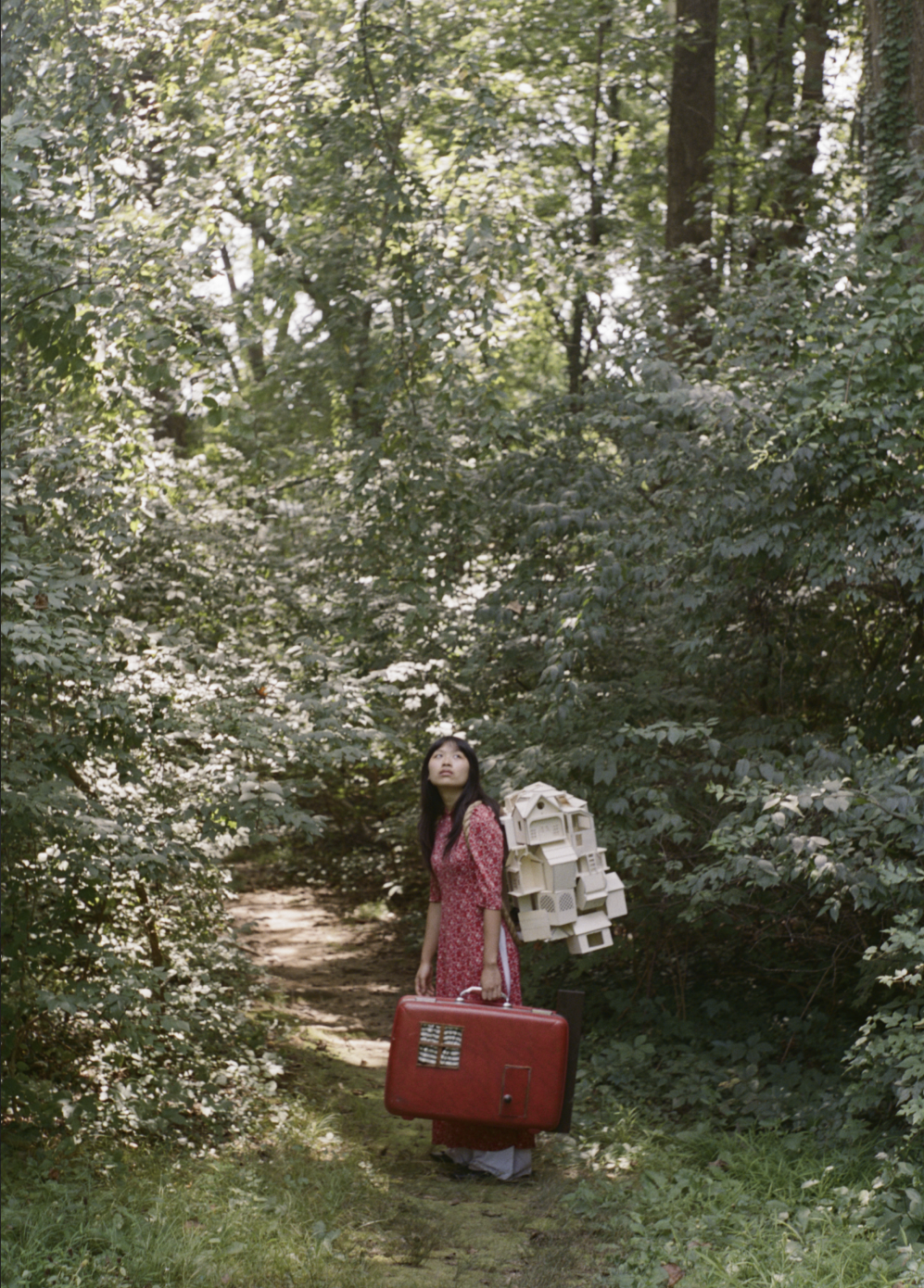
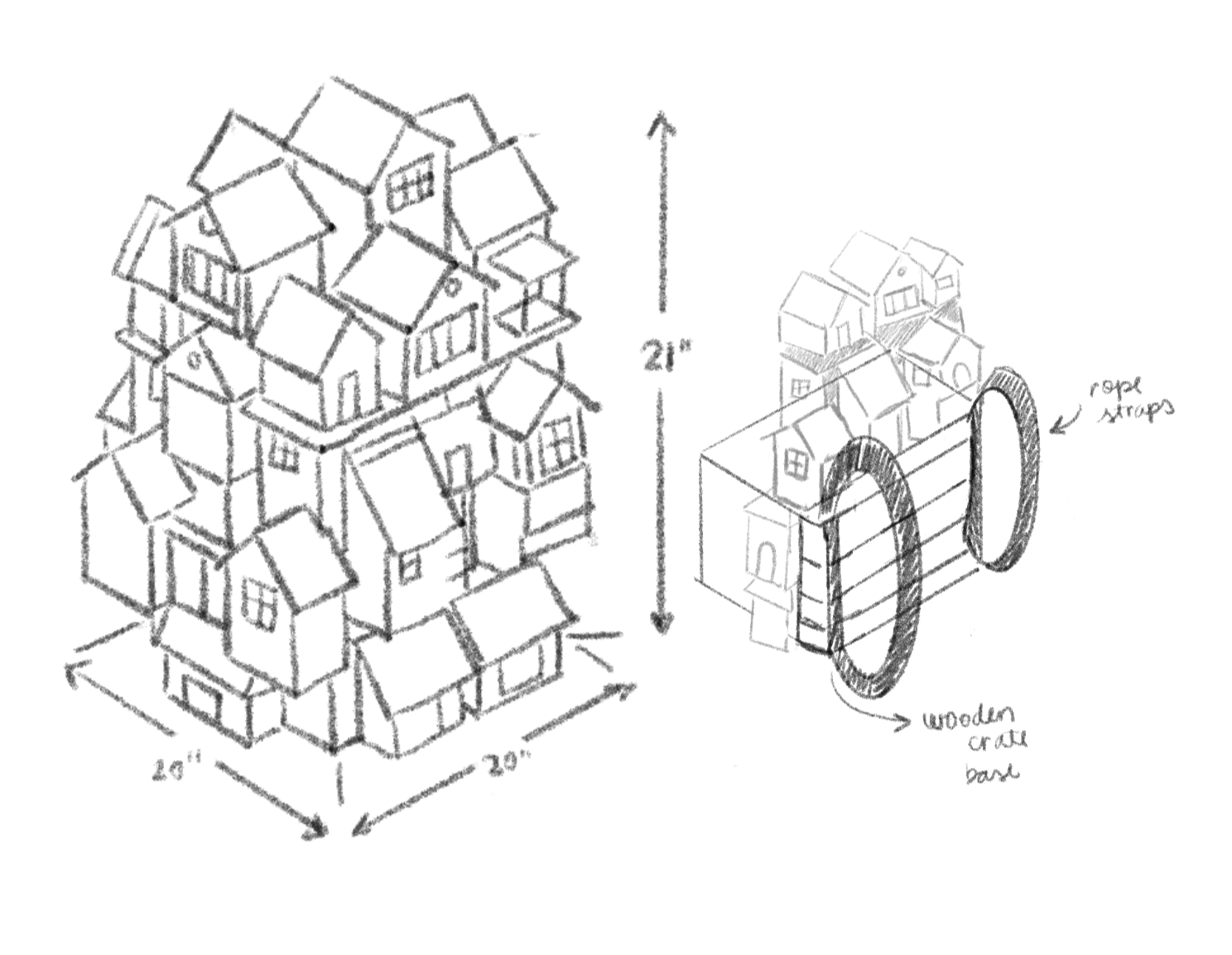
A backpack made of miniature houses stacked on top of each other. The design of it, is a geography that feels familiar to the artist: the way houses in the Brazilian morros and favelas grow upward and outward from each other, one on top of the other, the community itself becoming the architecture. To carry the backpack is not only to carry a house, it is to carry the hill it sat on, the neighbors whose walls it touched. The immigrant body moves with all of that strapped to its back- roots still dangling, not yet replanted.
The third house is the first built at full scale: twelve feet walls made of OSB board rather than wood, a material that is pressed and layered, that compresses everything into a single surface. It is the texture of memory: not a clean archive but an accumulation built of thoughts and memories. One person is still on the ladder painting the facade, another has already sat down beside the window to read. The house is mid-construction and already being lived in.
It is also a quiet acknowledgment of something rarely made visible: the hands building these houses, painting these walls, maintaining them (in physical and emotional levels) are so often immigrant hands. The house as a symbol of belonging is also a site of labor, and that labor has a body, a body that is rarely the one the house was built for. This is also the first time in the series where the setting is explicitly a film set with it's lights visible at the edges. A house is always, in some sense, a performance of belonging, constructed from the outside in: you build the walls, you hang the curtains, you sit beside the window until it feels true. There is no image in this series of a completed, settled home. Every house is in process, whether that is being built, being worn, being dismantled or being carried.
TEXTURE SWAP
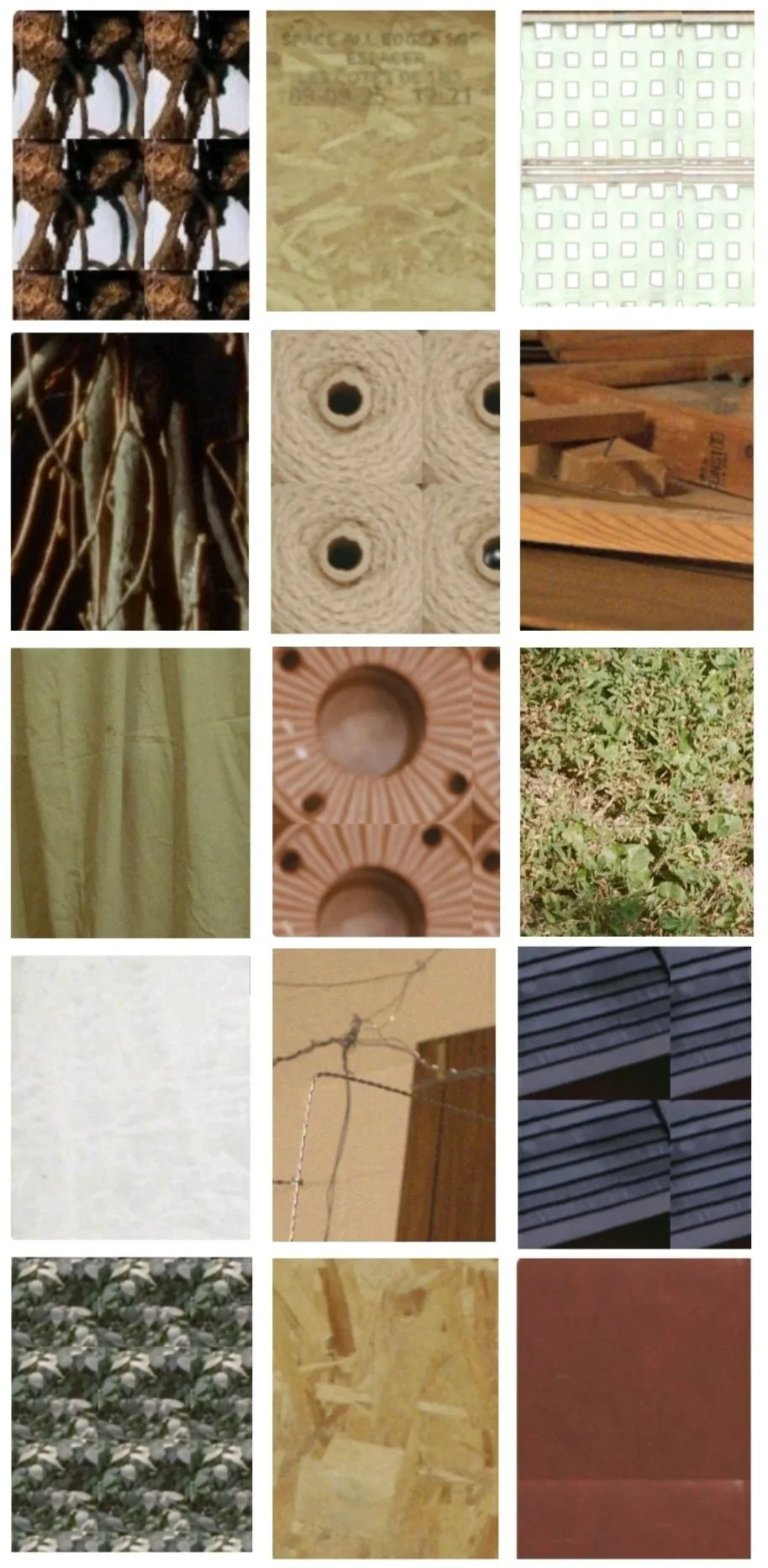
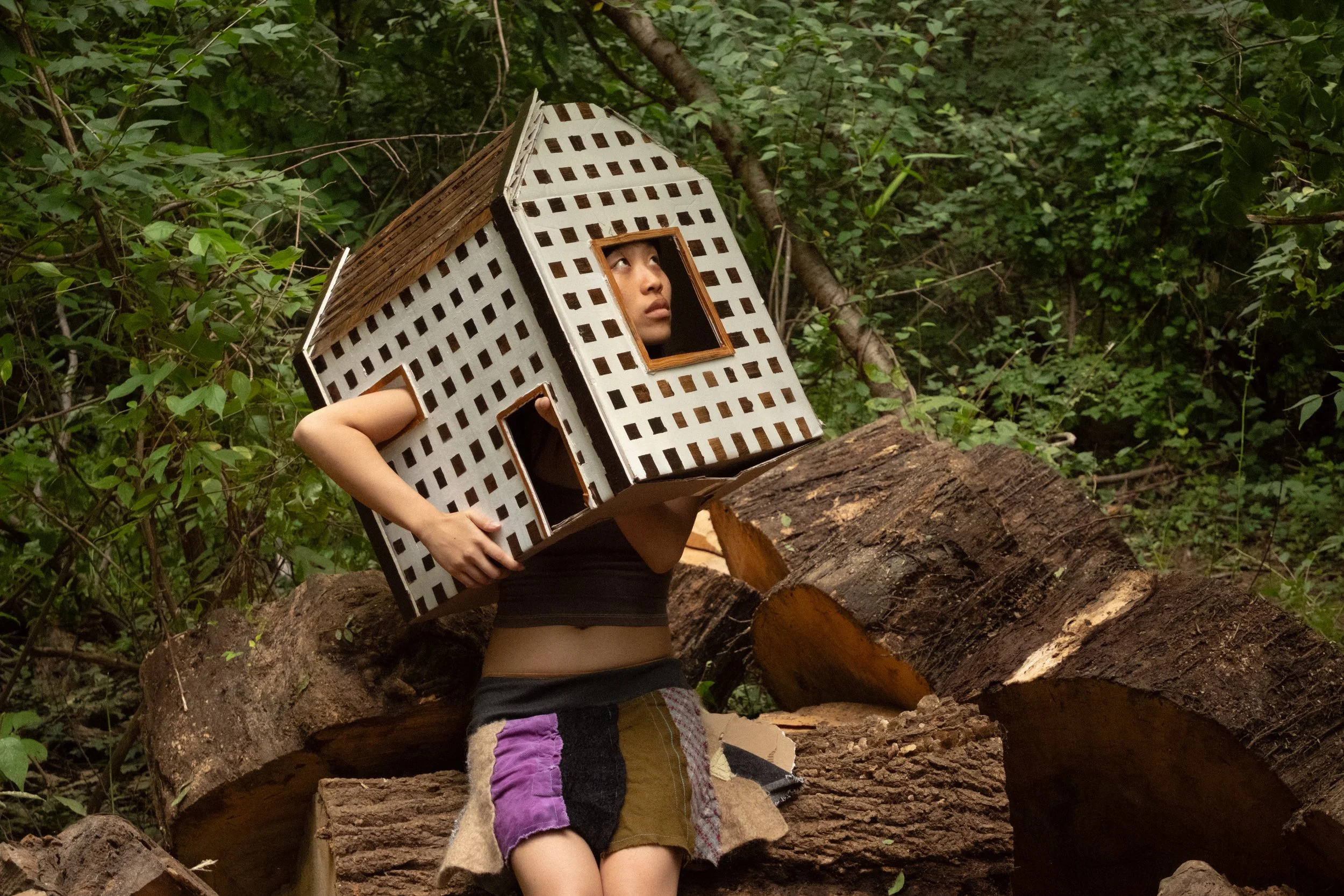
The next two houses use materials such as cardboard, patched cloth and leftover construction wooden planks chosen because they represent a particular state: the temporary that becomes permanent, the provisional that becomes the only structure you have. In the first image, the body wears the house. It sits tilted over the head like a crown that doesn't quite fit, and through the window, a face looks out. She is not trapped, yet not free- she is somewhere in between. The house is not protecting the body, the body is holding the house up. The costume, made by Vivian Nguyen, extends the logic of the house itself: patched cloth in different textures and colors sewn together, each piece from somewhere else.
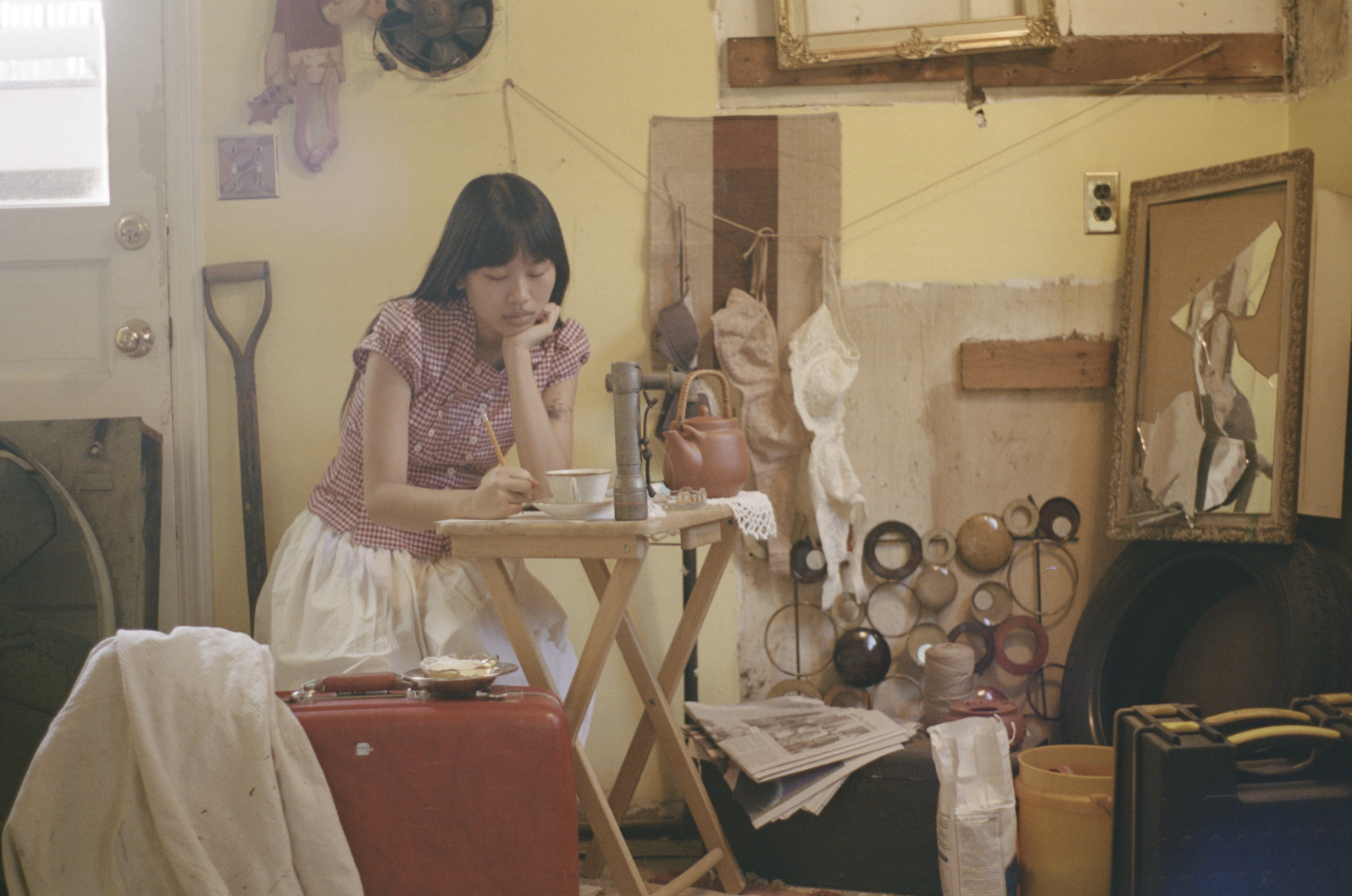
Now, the body is inside, looking out from within- it is the only moment in the series where we see the interior of a house, and because of that, it feels warmer, slower, almost dreamed. Every texture that moves through this series finds its way into this single frame: ropes, wires, ceramics, wood, cloth draped over things, newspapers. The room is filled with utilitarian objects, things kept because they are useful, or because usefulness became the only justification for holding onto anything. Together, they accumulate into something that looks, unexpectedly, like home. This is the interior the series has been circling: not a finished room, but a gathered one. Everything brought from somewhere else, arranged into a life.
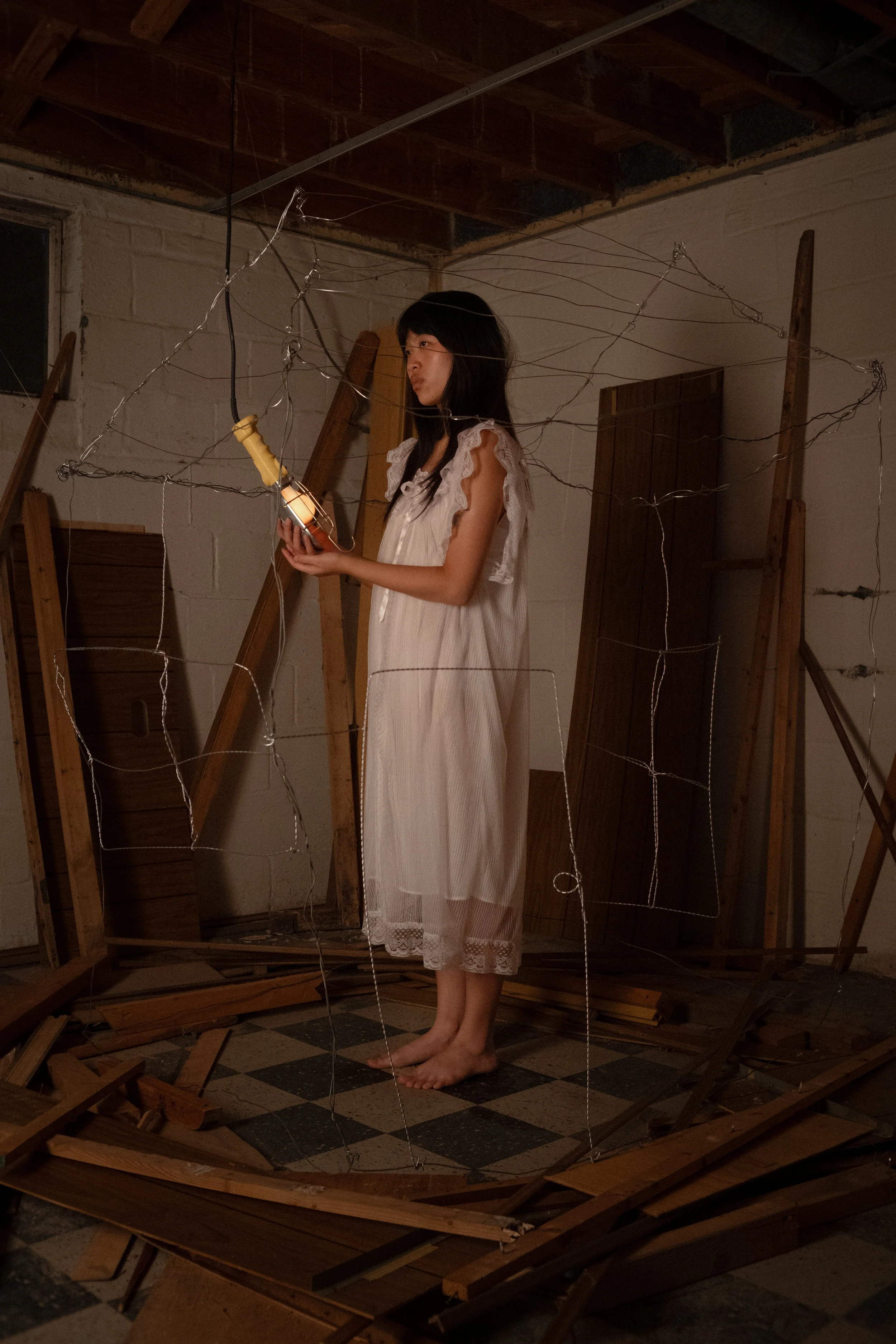
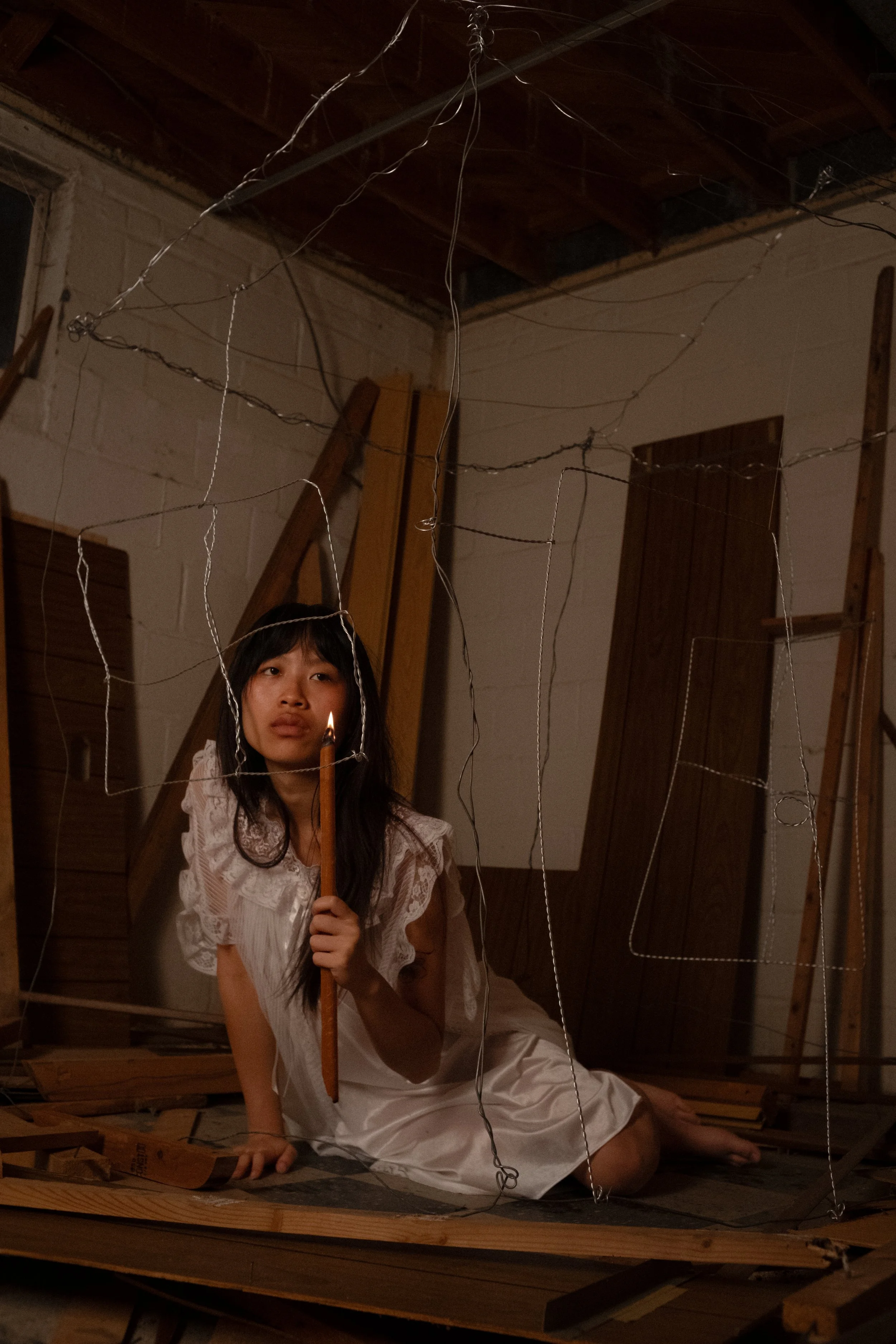
What is left is wire, bent and strung into the shape of a door, a window, the outline of a house. The house is now a vessel with no skin, a structure that holds nothing but its own memory of what it used to be. It sits inside another house, itself half-destroyed, the ceiling exposed, the floorboards broken and scattered. A house inside a house in ruins is a life cycle reaching its end. There is one light source, a single work lamp hanging from the ceiling, and a wooden stick, held upright like something between a tool and a staff. Electricity and wood: the most ancient and the most modern ways of saying “someone was here”, someone tried to make this livable. To be an immigrant is to be intimate with a particular kind of death, not of the body, but of the self. Parts of the person you once were are set aside - sometimes, for so long they stop being retrievable. For a new identity to take root in a new place, something else has to be put down. The wire house understands this: it has given up everything that made it a house (the walls, the warmth, the interior) and what remains is only the shape of what it was; the outline.
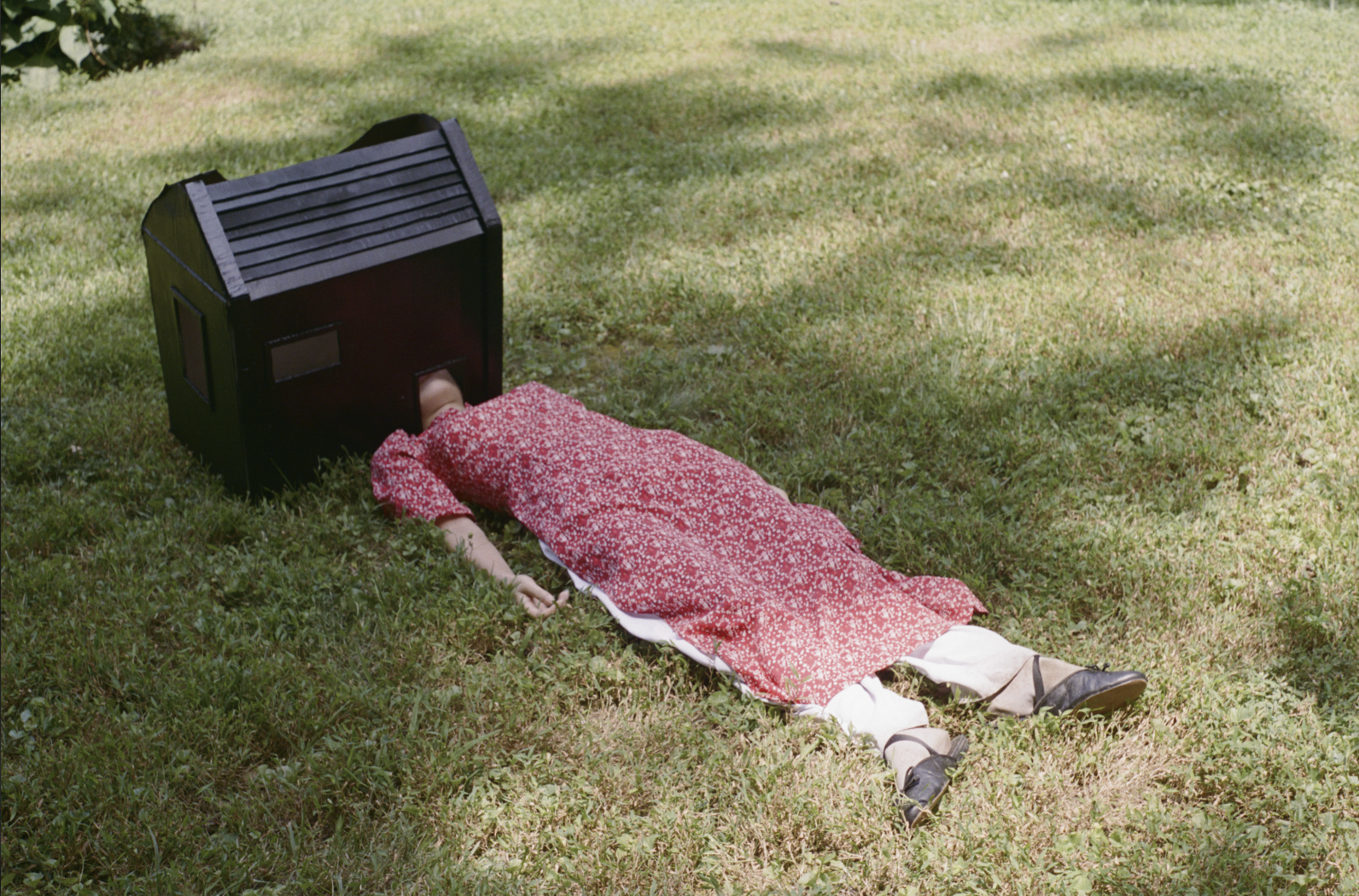
The house that was ripped from its soil in the very first frame has returned to it; now, it has brought the body with it. The life cycle closes here, in the sun, on the grass, quietly. The house and the body sharing the same ground at last, the same stillness, the same surrender to what the earth has always been waiting to receive back.
A house is one of the first things you learn to recognize. Yet, it is one of the last things you let go of. House of Passages moves between those two moments: the knowing and the releasing, tracing what gets carried in between. Immigration asks the body to do what no body does easily: to die a little, to cross, to begin again. These images do not resolve that; they sit with it- on the ground, in the dark, in the woods, in a room with a suitcase that is never quite unpacked. They ask not where you come from, but what you carry. And what, eventually, you return.
House of Passages was made in collaboration with the landscapes, interiors, and bodies that agreed to hold these questions for a moment, long enough to be photographed.
Created and Designed by: Stella Bolina
Photographer and Cinematographer: Cameron Meyer
Costume Designer: Vivian Nguyen
Poster Art: Cynthia Li
Talents: Vivian Nguyen, Janya Ramachandran, Sofia Bolina and Sam del Rio